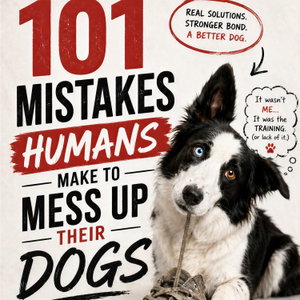
Welcome to the first episode of 101 Mistakes Humans Make to Mess Up Their Dogs.
This is not a podcast about perfect dogs—or perfect people. It is about the small, often well-intentioned things humans do every day that weaken communication, motivation, trust, and reliability without even realizing it.
Based on my new book of the same name, this series is about much more than correcting a list of training mistakes. It is about changing the way we think about dogs, behavior, and the relationship we create with them.
After more than three decades of training dogs, I know most people are not struggling because they do not love their dogs enough. Many of the biggest mistakes are made by devoted owners trying to do everything right. The problem is that we tend to view training from the human point of view. We focus on what we said, what we meant, and what the dog “should” understand.
But dogs do not enter our homes knowing English, household rules, or the meaning of our commands. They only know what their history has taught them.
Training is not simply making a dog obey. Training is communication. It is connection. It is the responsibility of one species to teach another how to live successfully in our world—without crushing the joy, confidence, drive, and personality that make dogs extraordinary.
My goal is not to create a dog who listens only because he has to. I want a dog who wants to engage, wants to play the game, wants to find the answer, and wants to come running when called. A dog can be excited and still have impulse control. A dog can be enthusiastic and still be responsive and reliable. Calmness is not the only measure of good behavior, and control should never require us to extinguish what we love most.
Throughout this podcast, we will examine the subtle habits that sabotage training: repeating commands, micromanaging, using a dog’s name as a correction, poisoning the recall by ending the fun, teaching from a tight leash, rewarding the wrong part of a behavior chain, and expecting reliability before we have built understanding and motivation.
We will also talk about something I believe is missing from many conversations about training: your value in your dog’s eyes.
Are you the most interesting thing in the environment, or are you competing with everything else? Are you building desire, or merely demanding compliance? Are you the source of fun, clarity, and reinforcement—or are you standing on the sidelines trying to call your dog away from the squirrel?
Sometimes, you have to become the squirrel.
That does not mean bribing your dog forever. It means understanding what drives behavior. It means becoming relevant. It means creating engagement before demanding attention and building a relationship in which listening to you means something worthwhile.
This podcast is not about choosing a training camp or arguing over labels. Those debates often distract us from the more important question: What is the dog actually learning?
Timing matters. Clarity matters. Motivation matters. Consequences matter. Your habits matter. The relationship matters.
In each episode, I will take one of the 101 mistakes and break it down from the dog’s point of view. I will explain why it happens, what the dog may be learning instead, and how one small change can transform the result. Every episode is designed to help you see training differently.
Your dog is always learning—even when you do not realize you are teaching.
This first episode is my introduction, my philosophy, and my why. I wrote this book and created this podcast because I want people to stop thinking only about how to control dogs and start thinking about how to communicate with them. I want to help you create a dog who is not just obedient, but connected; not just calm, but confident; and not simply trained, but truly engaged with you.
Welcome to 101 Mistakes Humans Make to Mess Up Their Dogs. Let’s change the way we think about training—one mistake at a time.